July here – like most of the country remained dry with extreme heat and we longed for rain. We need an exceptionally wet autumn and winter to restore the water levels both in the garden and the reservoirs. It has become increasingly apparent which plants survive and thrive in drought. Prairie plants such as grasses, rudbeckias, echinaceas, perovskia and echinops have thrived here but dahlias and sweet peas have suffered badly. There have only been enough sweet peas for just a small bunch to pick at any one time. Roses flowered well but much earlier and went over sooner than normal but Mediterranean plants have loved it. It’s an interesting challenge and climate change is forcing us to rethink and adapt our planting to cope with increasing summer drought.
To notice birds you have to watch them. I love when I get time to watch them watching me. We share the garden here with all sorts of birds. The first are those that dip in and out of our sky – swallows and swifts are among my favourites and when they go in September they leave such a loss until next April when they return. Also skylarks which we hear more often than we see them. Because we have a moat we have ducks, occasional geese, morehens, coots, a heron and we’re very lucky to have a pair of kingfishers – that wonderful electric blue of their backs and wings make them unlike anything else. We have ravens, crows and magpies and lots of jays down the drive, buzzards, kestrels, sparrowhawks and of course we have lots of pigeons. Then there’s the birds that occupy the body of the garden itself. A garden like this, lush with growth, seed, berry and leaf plus the unknowable numbers of insects and caterpillars – all of which provide the perfect home and food for song and woodland birds. Finches, tits, blackbirds, thrushes, robins, sparrows and wrens. All inhabit the garden here just as much as we or the plants do and provide the soundtrack. Hew has the Merlin app on his phone and loves to sit in the evening to identify the birds he can hear. Oh and we mustn’t forget Percy the pheasant who we feed every morning.
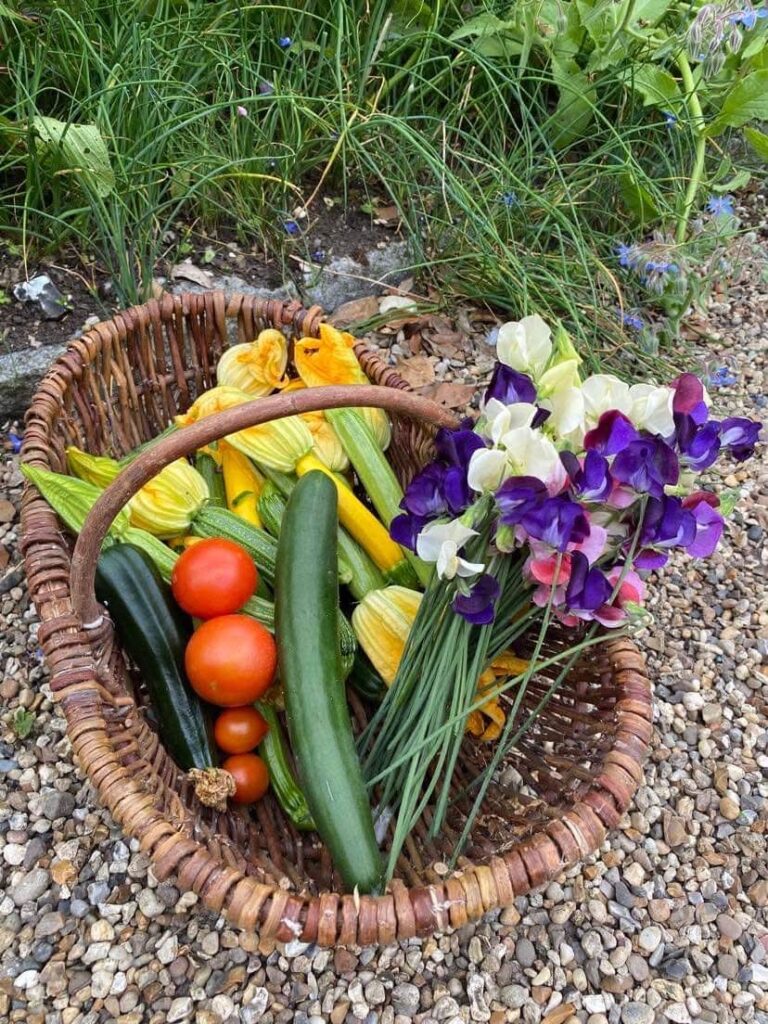
August is the peak of the vegetable year. It is the month of harvest and it is delivering crops such as tomatoes, French and runner beans, courgettes, basil which has done incredibly well this year and has thrived in the heat as well as successional crops such as lettuce, salad leaves and chard. It’s also prime seed collecting time. It’s free and I collect on a sunny, dry day (there’s certainly been plenty of those) I use brown envelopes – A5 the ideal size – and I carefully cut the seed head and upend them into the envelope, seed head and all, snip the stem off, seal it then store it clearly labelled with the date, name of the plant and then I store them in a cool, dry place. After a week or two the seed should be dry and can be sieved, cleaned and either sown or stored in sealed packets. My favourite plants to collect seed from are poppies, foxgloves, love-in-a-mist, hollyhocks and runner beans.
A huge thank you to the 138 people who came to my special talk here on July 31st. It was a wonderful evening and raised lots for St. Elizabeth Hospice. August is the last month of summer so relish it to the very last drop.
 Kate Elliott came to Columbine Hall in 1997 when she was sixteen. She is now head gardener but also helps with managing the property generally and in conducting guided tours.